Thursday, November 16, 2006

Someone else's garbage, our treasures


(by Marina)

People are amazed when they hear that we have paid off our (modest to begin with) mortgage, and they want to know how we did it. The plain answer is dumpster diving. I love dumpster diving. (We also call it "crow shopping," because crows like to check out what's on the curb, too, sometimes along with us.) I never know what I'm going to find, and while I don't always find what I thought I wanted, in the end, I seem to find what I need. And I've found that I end up needing what I find. A nice little circle there, and it's all free and legal. Where we live, the university student population moves once a year, and they throw out a truly astonishing array of things. One person's trash is another person's treasure, they say, but I have to wonder about the thinking behind some of these throwaways. I mean, just because one disc of your eight-disc complete Beethoven string quartets CD set gets broken, does it really make sense to throw away the other seven? And what about Goodwill and St. Vincent de Paul's? Some things I've found have told their own stories pretty clearly, like the handmade wooden cat carrier with "Kitty" painted on it, surrounded by flowers, and inside, a St. Jude's medal---the patron saint of lost causes: someone's dearly-loved cat who was lost, one way or another. Then there was the cardboard box containing two military-issue walkie-talkies (still working), some low-caliber ammunition, and an autographed photo of a young guy with very short hair and a name like Brett or Britt or maybe Rhett surrounded by the 1993 (I believe it was) members of the "Texas Bikini Team," whose big smiles were belied by their overly-made up eyes. I guess the Team never called him, like they said they would, so, after trying to contact them by walkie-talkie, he finally gave up and threw away their photo. (At least he got rid of the live ammunition---wasn't THAT upset about it.)

Anyhow, here's a partial list of things we have found in the "trash" in the past 5 years that have been in perfectly good condition: Cookie tins, silverware, blankets, dishes, candles, candleholders, pens and pencils, books, CDs, LP records, cassette tapes, a big recliner, wooden chairs, a cat tree, a cat scratching post cat carriers and litter boxes, aquariums, picture frames, lamps, towels, plants, pots for plants, cooking pots, cast iron frying pans, popcorn tins, microwave ovens and toaster ovens, writing and printing paper, leaf rakes, lawn chairs, insulated coolers, a mini-trampoline, exercise equipment (including a working treadmill), tables, doors, luggage, mops and brooms, reel lawnmowers, laundry racks, clothes (including a like-new North Face winter coat), shoes, bicycles, power tools, hand tools, bicycle tires, videotapes, VCRs, stereo tuners, bicycle parts, purses, CD players, bicycle trailers, dishracks, laundry baskets, notebooks, folders, a desk organizer, unopened reams of business stationary (good for printing out rough drafs), rolls of thick printer's paper as well as gift wrapping paper, sheets still in the package, a bookcase-style headboard, a huge antique chest of drawers, a small chest of drawers missing only one of its handles, spice racks, kitchen cabinets, sofa cushions, couches, futon frames, futons, incense burners, jewelry, framed art prints, charcoal grills, working radios, a beautiful purple and pink handmade and handpainted art supply case decorated with yellow tulips, crayons, canned food, cleaning products and sponges, children's toys, etc., etc.... Some of these things needed minor repairs; most didn't need more than a little wash-up.

And this was without even trying very hard, i.e., we don't go and hang out near dumpsters at big apartment complexes. If you did, you would likely find even more stuff. Whatever we can't use goes to friends, the Salvation Army shelter, Goodwill, St. Vinny's or the food bank. Food can be free, too----we grow our own vegetables and herbs, pick apples off trees that no one else seems to notice on public "wasteland," eat and cook vegetarian. Eating vegetarian really is cheaper if you *cook* and don't just rely on frozen "meat" substitutes. Every year, we make more pesto than we can eat out of wild garlic mustard (which grows everywhere now, it seems); I thought it would be very healthy but taste ghastly, but I was wrong, it was delicious, and a jar makes a nice gift, too. Here's the recipe from Wildman Steve Brill's edible wild foods cookbook, "The Wild Vegetarian Cookbook."

And that's how we paid off our mortgage, essentially, by gauging what it is we "need" by what we find as much as by what we want. I don't feel like I'm forcing myself to settle---on the contrary, I feel like more stuff comes my way than I can ever use, and plenty of it is high quality, too. The only reason we still work (and I work parttime now) is for health insurance, because we can get almost everything else we need from someone else's trash. Here's a great website for more fun and lots of info about "Dumpster Diving for Fun and Profit."

We also belong to a local Timebank, where we can exchange "time dollars" for other people's services, (and even fair-trade chocolate, wild rice and olive oil!), and get to know some nice people---but that's a whole story in itself. And I'm working on how to make personal care products: cheaper, better for the environment, healthier, but I do wonder: how much trouble will it be? Stay tuned...

Monday, October 23, 2006

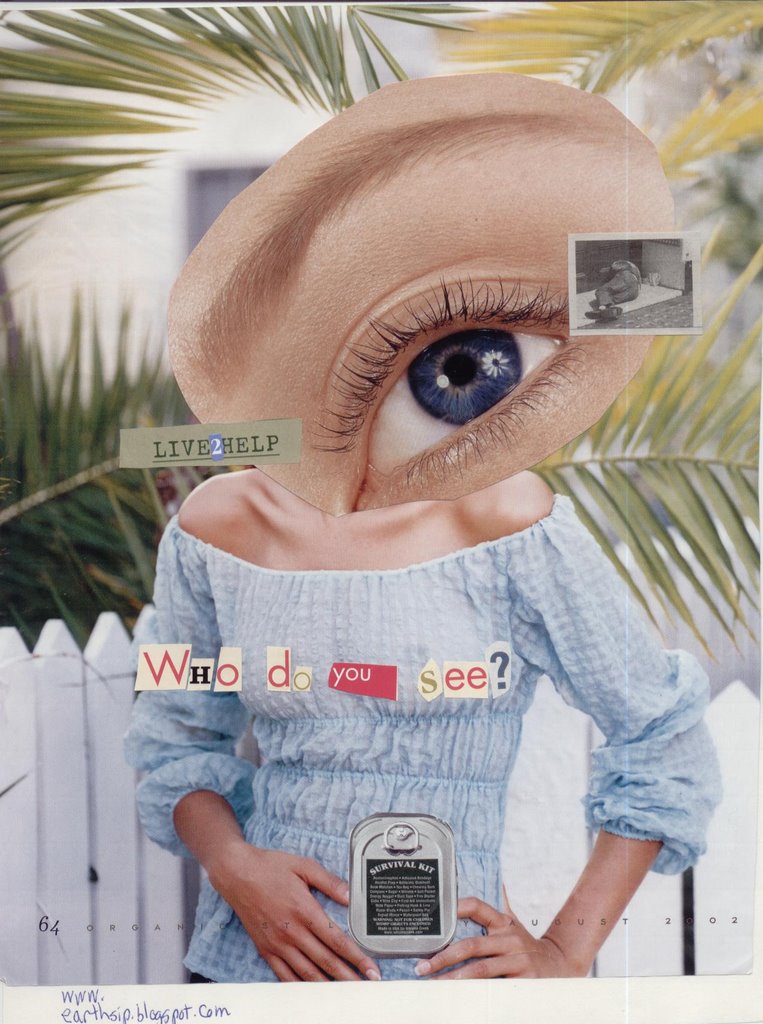
Survival Kit

Sunday, October 22, 2006

What it means to resist the war---and the little Hitler inside us

(by Marina)

"Dictatorship is a constant lecture instructing you that your feelings, your thoughts and desires are of no account, that you are a nobody and must live as you are told by other people who desire and think for you." --- Stephen Vizinczey

As much as this quote galvanizes resistance, I have also found it necessary to keep in mind what Mother Theresa once said, that she was led to do her work because she realized she had "a Hitler inside me." It's easy to tell other people how to live their lives, and another thing to listen to where they're coming from, important to shine a light on the suffering of the planet and animals so that others may see what was hidden, and another thing to stick with them as they show you their hidden fears and anxieties. Everyone has to start from where they are, and trying to dictate "the truth" to others dooms your efforts from the start. We on the political left need to remember this just as much as those on the political right. This Ken Nerburn quote says it all: "Remember to be gentle with yourself and others. We are all children of chance, and none can say why some fields will blossom while others lie brown beneath the August sun. Care for those around you. Look past your differences. Their dreams are no less than yours, their choices no more easily made. And give, give in any way you can, of whatever you possess. To give is to love. To withhold is to wither. Care less for your harvest than for how it is shared, and your life will have meaning and your heart will have peace."

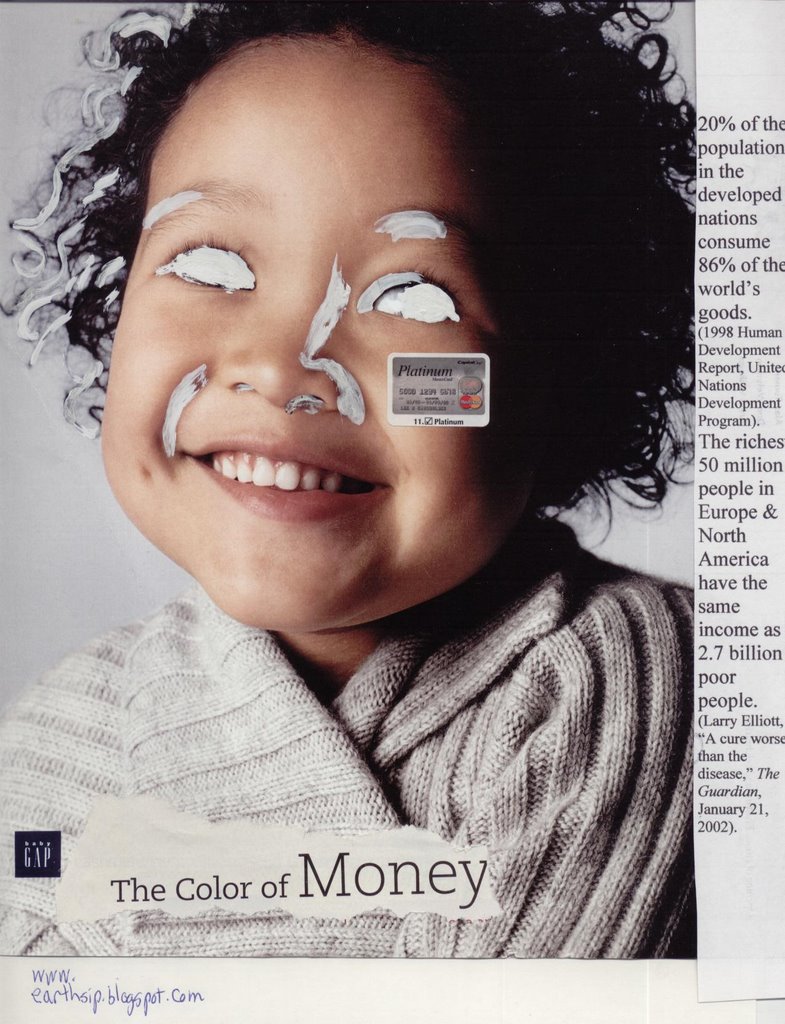
The Gap


(by Marina)

Except for one "Drawing 101" class, I'm not trained as an artist, so maybe that's why collage interests me: it's definitely grassroots, outsider art. Probably a stretch to say that it's inherently more political, though. And Wite-Out art, or, as I like to call it, "Planet Pleaser White Multi-Purpose Correction Fluid" art (since that is the vegan product that I use to create mine) is even more so. Easily accessed materials, found in most desk drawers nowawdays. Using Wite-Out/Planet Pleaser on an image feels similar to Asian brush painting: it's not about making lines go the way you want them to so much as creating spaces that weren't there before, and even further, creating what I think of as negative spaces. Like the child's eyes: what was warm and alive is negated, blanked out. The bottom right corner, where the paper pieces don't meet was intentional---only machines can make something perfect, and a machine is the last thing I want to be.

To find out how you're doing in the consumption realm, try this quick quiz.

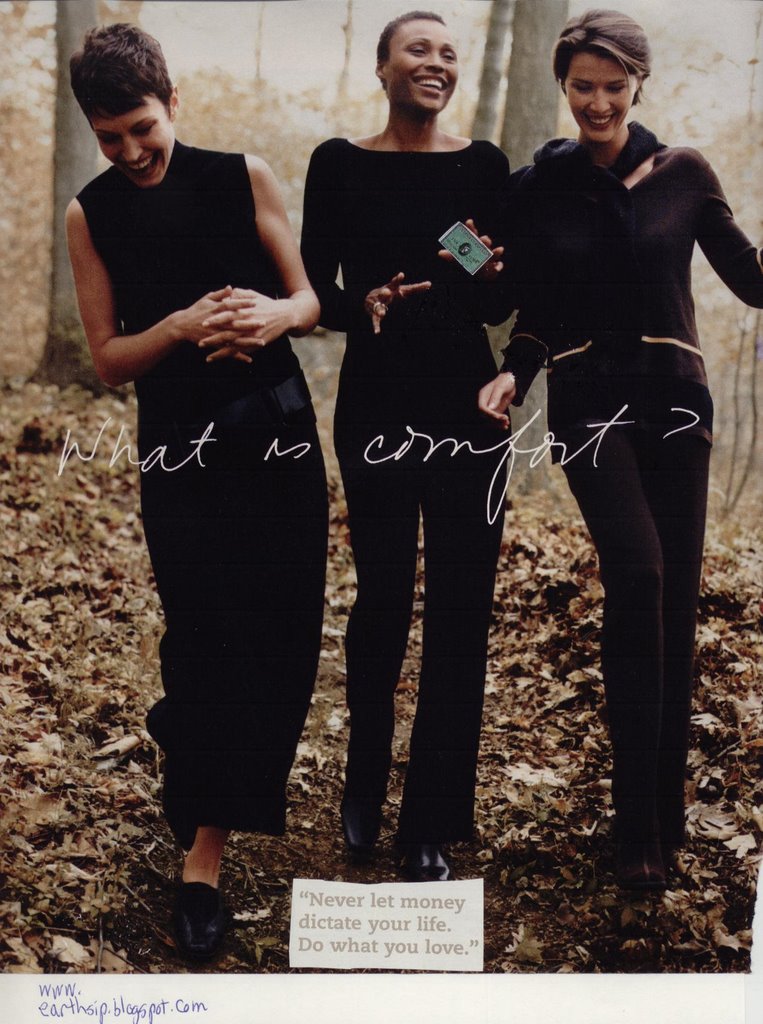
How many choices?

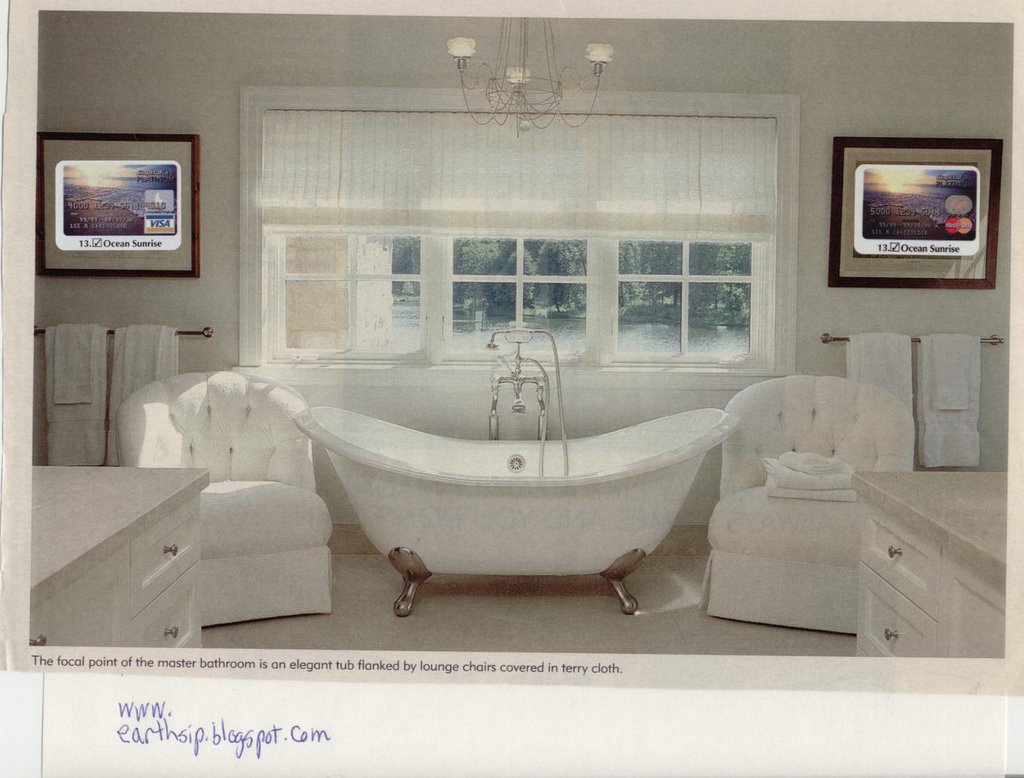
Illusions of Security

What is that is keeping you from your life?


(by Marina)

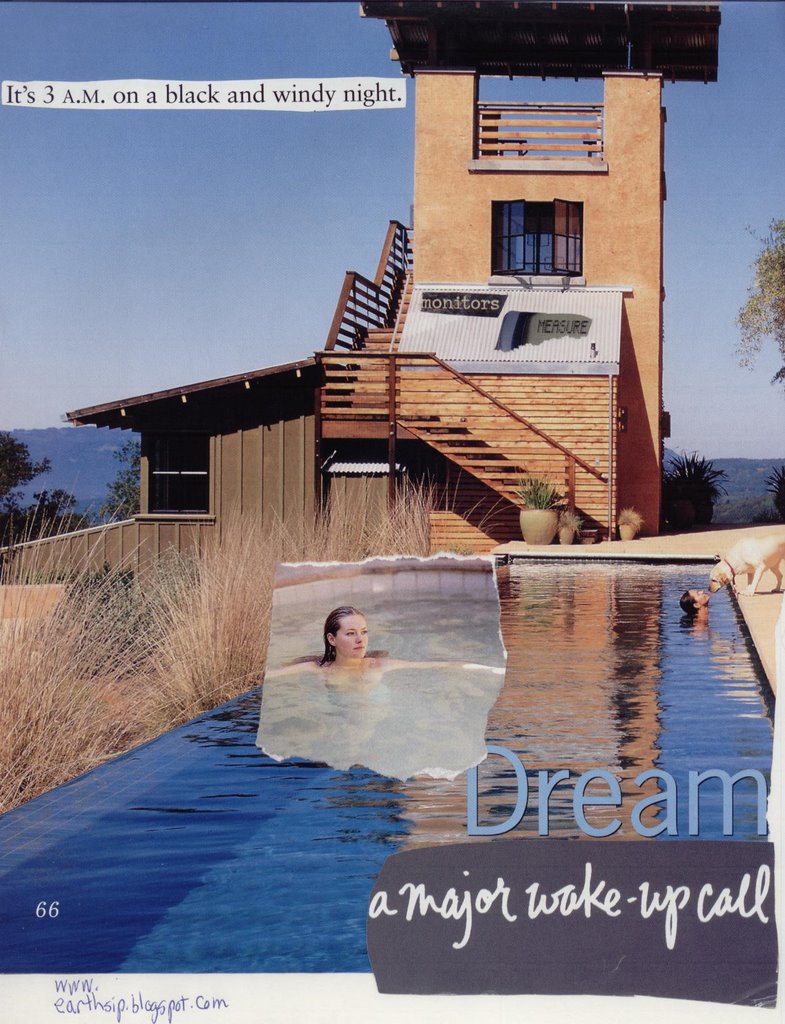
When I created this, I was thinking about how dreams often tell us the truth we can't tell ourselves in the daylight; how our dreamlife is just as real as our waking life; and how, even on a lazy, hot afternoon, we contain the seeds of that dreamlife self from when it's 3 am on a black and windy night. For one of my friends, it made him think, "What is that is keeping you from your life?"

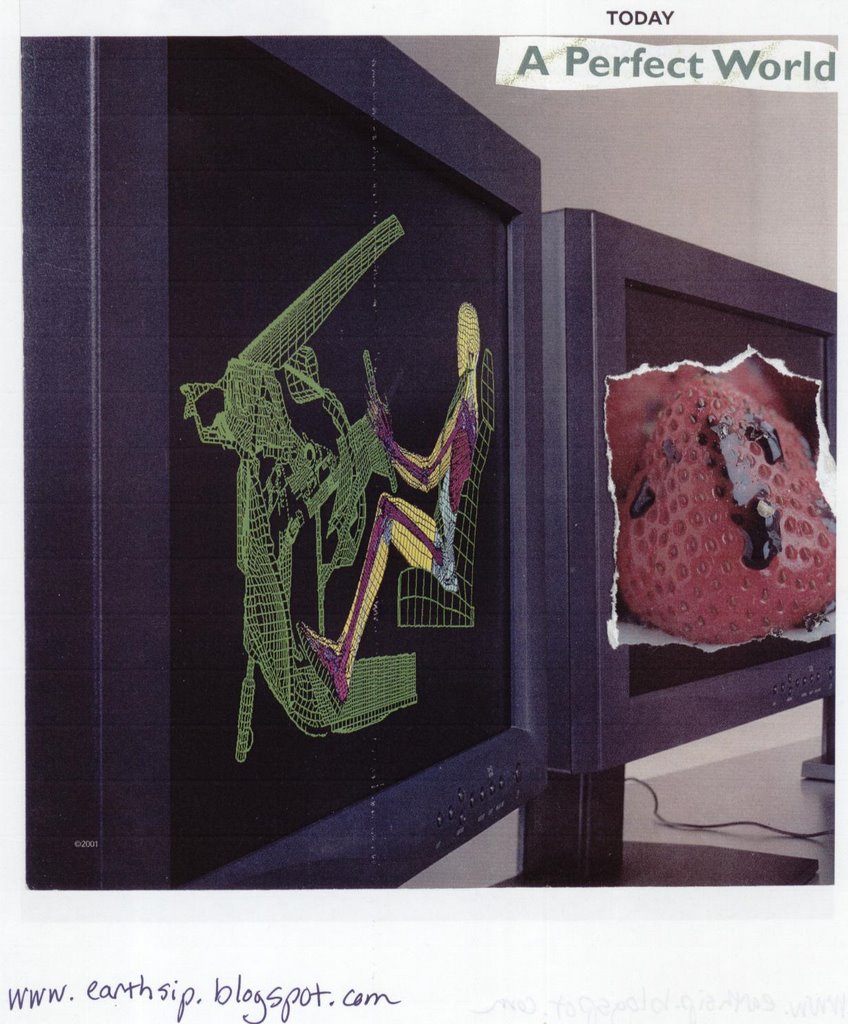
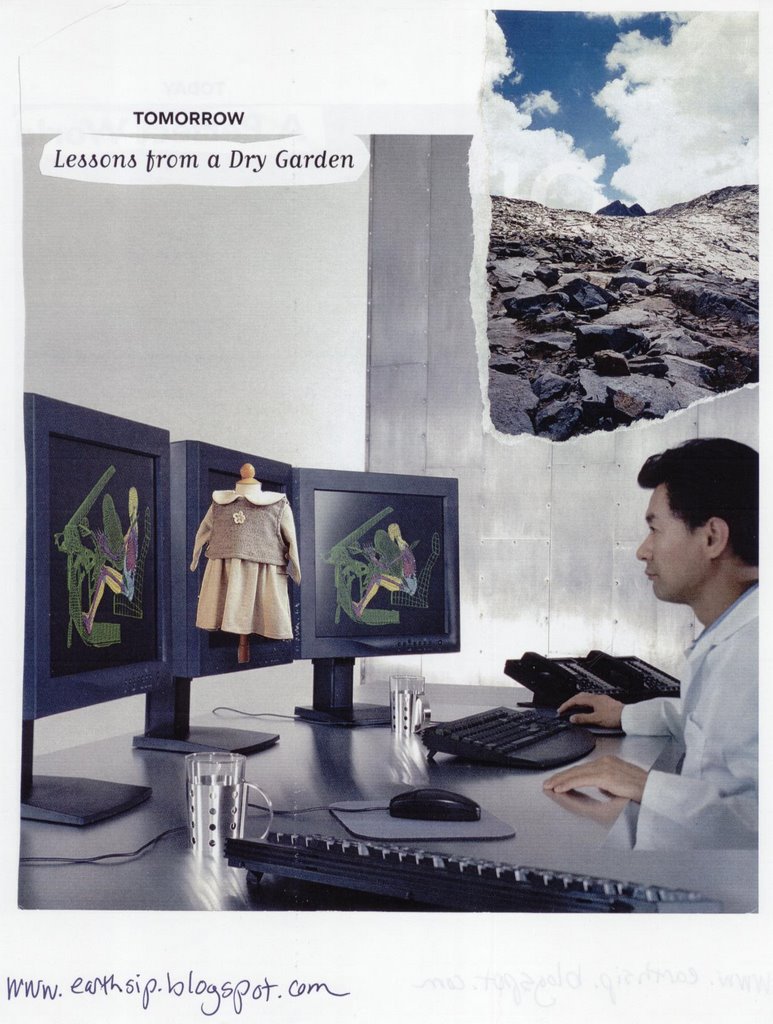
You might have entirely different thoughts about these images...

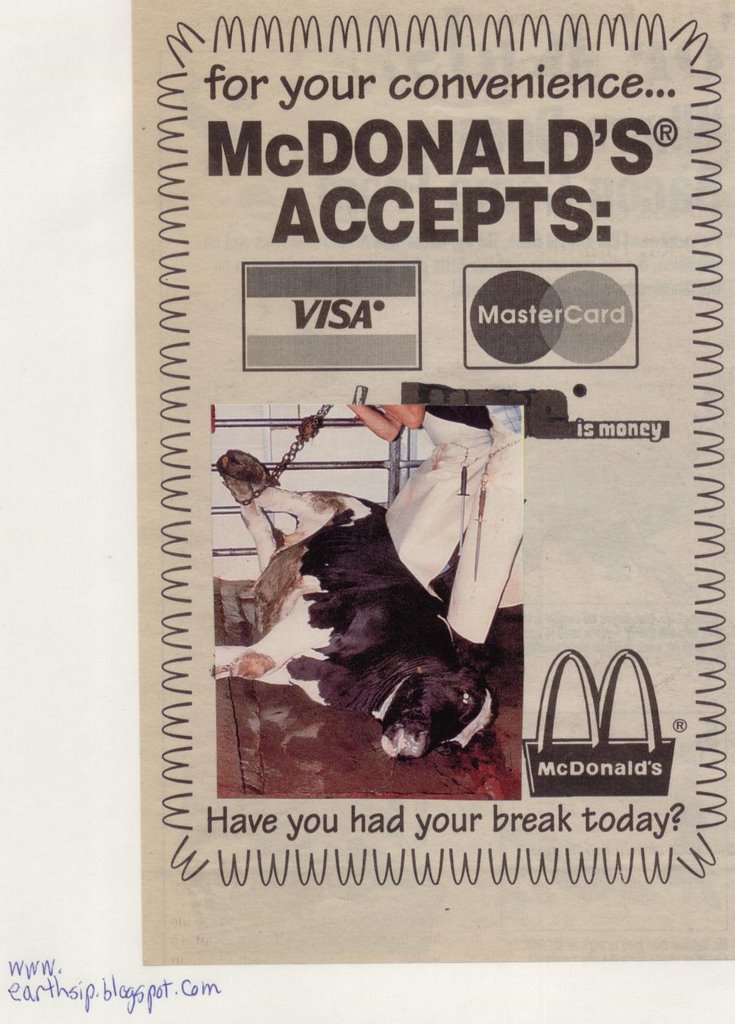
"A standard beef slaughterhouse kills 250 cattle every hour"


"The high speed of the assembly line makes it increasingly difficult to treat animals with any semblance of humaneness. A "Meat & Poultry" article states, 'Good handling is extremely difficult if equipment is "maxed out" all the time. It is impossible to have a good attitude toward cattle if employees have to constantly overexert themselves, and thus transfer all that stress right down to the animals, just to keep up with the line.'" --- from FactoryFarming.com

Wednesday, October 11, 2006

Saturday, September 23, 2006

Historical choices

Patriotic Choices

A simple solution to war and global warming

(by Marina)

A friend of mine, who has just turned 60, is quitting her job, retiring so that she can live on a $734 a month retirement income, thus, living below the federal poverty line, so that she'll no longer be paying taxes that go to support war.  She is an utterly amazing woman.  When the U.S. military was blaming a lack of yellow "caution" tape" for its failure to protect Iraqi children from abandoned munitions, my friend bought reams of tape and mailed it to them.  She has also visited Iraq as a member of a christian Peacemaker team, and in the article she wrote about the experience, she points out that among its many "downsides," war contributes to environmental degradation and global warming.  Hoping to minimize her impact on the planet, my friend uses almost no electricity, has no car, avoids recreational travel, and buys locally produced food. In a local newspaper article about her decision to be poor, she says, "It's wrong for people to keep looking for someone to lead us. We all have to take personal responsibility. I want people to know this is an alternative." I would add that to take responsibility is to empower yourself, an invigorating and peaceful act. I only hope I can do so much.

Wednesday, September 06, 2006

The trees and the forest

(by Marina)

I recently left a job that I had done for nearly six years, a social services government job that meant a great deal to me, that I considered a part of my spiritual practice. This job was, I hoped, a way to practice Thich Nhat Hanh's Fourth Mindfulness Training: awareness of suffering, trying to be present for those who suffer, so we can understand their situation and help them transform their suffering. And this is where the limitations of this job revealed themselves. Being with my clients meant I needed to take the time to listen to them, and be open to what they needed help with, but that wasn't acknowledged as part of the job, really. The "real" job was grilling them for information so I could decide whether or not the government considered them deserving of a monthly sum that most of us would not consider to be enough to do much more than pay rent and buy some very basic groceries.  I wasn't there to be a guide or to be present: instead, I was a judge. Either they met the standards for the program, or they didn't, and if they didn't, I wasn't able to refer them to some other potential source of assistance because we had no training in that area at all.  

What I learned is that the U.S. social service safety net has a big hole in it, and eventually, I began to feel complicit in this corruption of democracy. The Eleventh Mindfulness Training deals with right livelihood, and reminds us not to live with a vocation that is harmful to humans and nature.  Every day, I had to ask myself: Does this work help realize my ideal of understanding and compassion? Is it at least a step in that direction? I barely had time to answer the question; I was too busy working, doing what they wanted me to do. I was becoming cynical, angry, closed off, abrupt and irritable. I wasn't sleeping well, and had little energy to do anything when I got home from work.  Being a judge wasn't something that I could stomach any longer...in truth, I was starting to feel like a jailer, herding people back into cages where they could be kept under control and away from more fortunate members of society---as though any one of us couldn't just as easily find ourselves in the same position.

In "Truth or Dare: Encounters with Power, Mystery and Authority," Starhawk poses the question: What would you do, how would you live, if the revolution wasn't something far off, was already here, happening right now? I thought more and more about that...and it became obvious to me that if compassion (instead of the economic bottom line) was designing a world, the job I was doing for the government simply wouldn't exist. I got out of there a few months ago, and feel much better about what I'm doing now, a job at a college, working directly with students. I'm still kind of a judge, but I'm in a better position to help them navigate the system, at least.

I don't understand much about economics, but all around me, I see the evidence: We need to start taking care of people, and, instead of judging them for what they lack, ask ourselves if their basic needs are being fulfilled, and what they have to offer. In the process, we will all benefit.

You can read about the 14 Mindfulness Trainings and see Starhawk's homepage

Tuesday, September 05, 2006

Monday, September 04, 2006

Labor Day: Do we work for caring or for killing?

"As a kid I dreamt of becoming a doctor. I wanted to help people in my village who did not have the money to pay for even basic health services. I never became a doctor. My family could not afford it. Instead, I worked for the pharmaceutical industry. My job was to peddle the myth that good health can be bought in the form of pills. I was good at it. Money came quickly and easily. One day, a friend asked me to help with health work with grassroots people. It hit me that the lies I helped peddles had mothers scrimping on their family's food to buy medicines they didn't need. Without food---the very thing they did need for their health---many died. They died so that I could have an easy life and drug companies could make huge profits. After four years, I quit my job. My experience taught me that refusing to kill is not only a call to people directly involved in the military machine. It is a call for all of us to consider whether we are complicit in people's death and disability. Do we work for caring or for killing? I am now actively involved in the campaign to put an end to the business of killing lives in the greed for money and power. Like the doctor I never was, I have vowed to use my skills to make people better. The killing business thrives on lies. It is my business now to help tell the truth." ---from www.globalwomenstrike.net

Saturday, September 02, 2006

"Not Left Behind: Rescuing the Pets of New Orleans"

Best Friends Animal Society, the group I worked with after Hurricane Katrina, has just published an amazing new book of photos,  "Not Left Behind: Rescuing the Pets of New Orleans," (publication date: August 21, 2006; $19.95 hardcover).  Best Friends calls it "a collection of images of hope and stories about happy endings for the pets stranded as the waters rose," by photographer, Troy Snow, who was a member of the first rescue team that scoured the flooded streets of New Orleans by boat, seeking the pets that evacuees had been forced to leave behind. With the typical Best Friends can-do attitude, the press release says: "At a time when the country continues to analyze what went wrong during and after Hurricane Katrina, it's refreshing - and inspiring - to be reminded of what went right. Best Friends Animal Society operates the country's largest sanctuary for homeless animals, and works with its members, and with shelters and rescue groups nationwide, to provide adoption, spay/neuter, and educational programs, and to bring about a time when there will be no more homeless pets." To see photos and find out more about the book, (and order a copy---or two!), go to: http://www.bestfriends.org