Humane myth. An idea being propagated by the animal-using industry and some animal protection organizations that it is possible to use and kill animals in a manner that can be fairly described as respectful or compassionate or humane.
We are a community of former farmers, animal rescuers, animal sanctuary founders, educators, and artists working to create a just and nonviolent future.
Currently, both the animal-using industry and some animal advocacy organizations are propagating the idea that it is possible to use and kill animals in a manner that can be fairly described as respectful or compassionate or humane. We believe that this "Humane Myth" misrepresents the realities of animal use, and cultivates a positive image of activities that are neither just nor kind nor sustainable. The purpose of the web site is to correct the misinformation that is associated with the Humane Myth, and to inspire a form of working for the peaceful transformation of our society that fully respects the inherent dignity and worth of animals and people alike.
The public deserves to be told the full truth of who animals are and what is being done to them behind closed doors, as well as the catastrophic impact that the continuing consumption of meat, eggs, and dairy products will have on human health, wildlife and the environment. We will do all we can to uphold this public trust.
As animal advocates committed to compassion and justice, we will refuse to take part in the exploitation of others or to collaborate with those caught up in such injustice. We will do our best to present a clear and uncompromised message to the public, a sincere and respectful message that is free of cynicism and manipulation.
Recognizing that progress toward social justice is gradual and depends on more and more people becoming aware of the truth, we will do all we can to insure that each of the steps our culture takes is toward an accurate understanding of the ways animals are being harmed, and away from the false and misleading idea that the production of meat, eggs, and dairy products can be carried out without cruelty, violence, or injustice.
Recognizing that fostering cultural transformation requires a variety of creative approaches, we will support a broad range of nonviolent programs and initiatives that eliminate or reduce the use and killing of animals, as well as measures that reduce the level of abuse and agony experienced by animals being exploited for human purposes, provided such measures involve NONE of the following:
1. Offering a misleading or incomplete portrait of the confinement, social deprivation, mutilation, reproductive manipulation, indignity and premature death endured by animals being exploited for profit.
2. Minimizing or failing to reveal the full impact on human health, wildlife and our environment from the continuing production and consumption of animal-based foods.
3. Developing, endorsing, certifying and/or promoting any animal products, including those that are labeled as being "humane," "cruelty-free," "cage-free," "free range," "organic," "compassionate," etc.
4. Developing, endorsing, praising, applauding or promoting "new and improved" methods for using and killing animals.
5. Providing individuals or corporations with promotional or public relations benefits that have the effect of making the use and killing animals or the sale of any animal product more profitable or more socially acceptable.
James LaVeck and Jenny Stein
http://www.humanemyth.org/

Sunday, January 04, 2009


1616 Free-Living Buffalo Were Killed in Winter 2007-08: How Can We Stop This Carnage?

IS THIS OKAY WITH YOU?
As of April 16, 2008: Yellowstone National Park had trapped over 1,600 wild bison migrating to winter range in the Gardiner Basin, and sent 1,276 bison to slaughterhouses. Hundreds more bison are trapped inside pens at Stephens Creek operated by the U.S. National Park Service. 7 wild bison died or were killed as a result of injuries suffered in captivity at Stephens Creek. 6 wild bison were shot by livestock inspectors for migrating just beyond the park borders. 112 wild bison have been separated from their mothers and family groups and sent to a USDA quarantine pen near Corwin Springs, Montana. The Montana Department of Livestock has trapped 146 wild bison on Horse Butte on national forest land and private lands, and shipped them to slaughterhouses. Another 166 wild bison were killed by hunters. By the Park Service's own estimate, two-thirds of Yellowstone's bison herd have been slaughtered or perished in the winter kill this season. Since the bison "plan" went into effect in 2000, over 3,500 wild bison have been slaughtered or removed from America's last wild bison herd. As if this wasn't bad enough, the cost of this wanton slaughter of America's last wild bison herd is all paid for by the American taxpayer, averaging $3,000,000 a year - now eight years into a fifteen year "plan".
CONTACT THE PEOPLE IN CHARGE!
http://www.buffalofieldcampaign.org/stoptheslaughter.html
Buffalo Field Campaign is the only group working in the field, every day, to stop the slaughter of the wild American buffalo. Volunteers defend the buffalo and their habitat and advocate for their lasting protection. Currently, the Montana Department of Livestock manages wild bison that enter Montana, a role authorized under MCA 81-2-120. Under this law, crafted by Montana's cattle interests, wild bison are managed as diseased pests and forbidden to enter the state without being subjected to harassment or death. "It is a serious conflict of interest having the Department of Livestock in charge of managing wild bison," said Mike Bowersox, a coordinator with Buffalo Field Campaign, "You might as well trust the fox with guarding the henhouse."
Bison Advocates are calling on the Montana Legislature to repeal MCA 81-2-120, and instead support reasonable alternative management of wild bison as outlined under the Montana Wild Buffalo Recovery & Conservation Act of 2009. The Montana Wild Buffalo Recovery & Conservation Act of 2009, crafted by the Bozeman based Gallatin Wildlife Association, would place the management of wild bison in the hands of Montana Fish, Wildlife & Parks. The bill would also recognize wild bison as a valued native wildlife species of Montana. The bill also provides for the protection of private property for landowners who do not welcome wild bison.
For decades Montana has been squandering a national treasure by perpetuating a wild bison killing spree that has no basis in sound science nor any reasonable foundation whatsoever," said Buffalo Field Campaign spokesperson Stephany Seay. "It's time for sensible change; it's time to welcome wild bison back home to Montana."
CONTACT THE PEOPLE IN CHARGE!
http://www.buffalofieldcampaign.org/stoptheslaughter.html
Wednesday, December 17, 2008
My Mother: Tireless Pioneer for Animal Rights

My mother worked hard for animals all of her 77 years of life, until she suddenly passed away this past March. Having founded the Coalition for Animal Protection in Omaha, Nebraska, in 1991, she served as its president until 2006, working tirelessly with CAP, accomplishing real social changes for animals. Throughout the last 17 years of her life, my mother worked with many other volunteers and rescued and fostered stray cats and dogs, cared for feral cat colonies through TNR (Trap, Neuter, Release), got mandatory spay and neuter laws passed in Omaha, helped low-income people pay pet veterinary bills, held low-cost spay/neuter and vaccination clinics, held free hay giveaways for dog houses every fall, educated the public about puppy mills and spay/neuter, helped lobby for prosecution in cruelty cases, and advocated for kindness to animals by holding demonstrations against circuses, rodeos and cruel animal experiments at Boystown Hospital, and by promoting veganism and spaying/neutering cats and dogs. CAP disbanded in 2006, but if you would care to make a donation to an animal rights group in her memory, please do it in honor and memory of the cats and dogs of Omaha, Nebraska, and consider donating to her favorite publication, the online animal rights newspaper ANIMAL PEOPLE.
Missy Girl: July 12, 1992 - June 5, 2008 RIP


Gengmiss Khan, Melissa Missy and the Jackbooted Missies, Missolini, Missy Girl, Saddam Missein, Slobodan Misslosevic, Slubers, T. Herman Missal, The Missy...
The Amazing Poultry Sisters
AKA Sophia and Sara Fezziwig Chicken (L to R). (I gave them the middle name of Fezziwig because they have what look like sideburns, reminiscent of the character Fezziwig in Charles Dickens' "A Christmas Carol.") Here they are in August, at about three and a half months, perching on our back porch railing, hoping for special treats before bedtime. Little blue eggs appear in their nest box every other day or so. (Sophie was the first to lay, back in early November.) What are vegans doing with chickens and eggs?! (You might be wondering.) Even though we don't believe that humans need to eat animal products to be healthy, we have eaten a few eggs from time to time from my (vegetarian) sister-in-law's rescued chickens. When we started getting involved in and learning more about sustainability and permaculture, keeping chickens for eggs became a question for us since eggs are one way of getting protein without wasting alot of resources to do it. We still aren't entirely comfortable with it. But most vegans were vegetarians first, and we do plan to sell some of the eggs. If folks are transitioning from veggie to vegan, or even if they never even go veggie, better that they eat eggs than "meat," and better that they get those eggs from chickens who are treated well in every way, and who will never be slaughtered, whether they are laying or not.

Now that it's winter, Sara and Sophia live in a wonderfully snug coop that Steve built for them, where they can go out into an enclosed space during the day, and peck at their head of cabbage, as well as other morsels (soy okara, rice, tomatoes, plums, any kind of greens, and tempeh are favorites). They can go back up into their loft bedroom any time they want, where they have a heater. The temperature is easily monitored indoors, and if it starts getting too cold out there, we heat up big cans of water (empty olive oil cans) in the oven for them.
Their personalities are so different---Sara is the leader, but Sophia is more outgoing. Where Sara holds back, Sophie rushes in enthusiastically. For months, they were wild for worms, and would rush to wherever Steve was digging in his gardening to look for them. By the time fall came, they were less interested in worms, though, maybe knowing their protein needs had changed? They're very happy girls, and love to be held and scritched around their neck feathers.

Now that it's winter, Sara and Sophia live in a wonderfully snug coop that Steve built for them, where they can go out into an enclosed space during the day, and peck at their head of cabbage, as well as other morsels (soy okara, rice, tomatoes, plums, any kind of greens, and tempeh are favorites). They can go back up into their loft bedroom any time they want, where they have a heater. The temperature is easily monitored indoors, and if it starts getting too cold out there, we heat up big cans of water (empty olive oil cans) in the oven for them.
Their personalities are so different---Sara is the leader, but Sophia is more outgoing. Where Sara holds back, Sophie rushes in enthusiastically. For months, they were wild for worms, and would rush to wherever Steve was digging in his gardening to look for them. By the time fall came, they were less interested in worms, though, maybe knowing their protein needs had changed? They're very happy girls, and love to be held and scritched around their neck feathers.
Tuesday, October 14, 2008
Happy Horses!


My (Marina's) stepfather Andy loves horses and is, for all intents and purposes, a horse whisperer. (He has two, Wendy and Kahn.) Here he is with Steve's sister, Donna, who has six horses, all rescues, like all her animals. Her newest, a two year-old filly named Brandy is in the second photo; she was kept in a stall literally all the time until six months ago, so she's small and still a bit undernourished. In the next photo, Andy's riding Dudley and Donna is on Mandy. (Are you detecting a strange theme in the names here? Donna claims it's accidental.)
All the horses at Donna's lead fabulous lives, sharing their field and barn with three llamas, three goats and two sheep, and if they get tired of each others' company, they can always trade whinnies over the fence with her friend Jackie's horses, who are right next door.
Saturday, February 23, 2008
Thursday, November 16, 2006
Someone else's garbage, our treasures

(by Marina)
People are amazed when they hear that we have paid off our (modest to begin with) mortgage, and they want to know how we did it. The plain answer is dumpster diving. I love dumpster diving. (We also call it "crow shopping," because crows like to check out what's on the curb, too, sometimes along with us.) I never know what I'm going to find, and while I don't always find what I thought I wanted, in the end, I seem to find what I need. And I've found that I end up needing what I find. A nice little circle there, and it's all free and legal. Where we live, the university student population moves once a year, and they throw out a truly astonishing array of things. One person's trash is another person's treasure, they say, but I have to wonder about the thinking behind some of these throwaways. I mean, just because one disc of your eight-disc complete Beethoven string quartets CD set gets broken, does it really make sense to throw away the other seven? And what about Goodwill and St. Vincent de Paul's? Some things I've found have told their own stories pretty clearly, like the handmade wooden cat carrier with "Kitty" painted on it, surrounded by flowers, and inside, a St. Jude's medal---the patron saint of lost causes: someone's dearly-loved cat who was lost, one way or another. Then there was the cardboard box containing two military-issue walkie-talkies (still working), some low-caliber ammunition, and an autographed photo of a young guy with very short hair and a name like Brett or Britt or maybe Rhett surrounded by the 1993 (I believe it was) members of the "Texas Bikini Team," whose big smiles were belied by their overly-made up eyes. I guess the Team never called him, like they said they would, so, after trying to contact them by walkie-talkie, he finally gave up and threw away their photo. (At least he got rid of the live ammunition---wasn't THAT upset about it.)
Anyhow, here's a partial list of things we have found in the "trash" in the past 5 years that have been in perfectly good condition: Cookie tins, silverware, blankets, dishes, candles, candleholders, pens and pencils, books, CDs, LP records, cassette tapes, a big recliner, wooden chairs, a cat tree, a cat scratching post cat carriers and litter boxes, aquariums, picture frames, lamps, towels, plants, pots for plants, cooking pots, cast iron frying pans, popcorn tins, microwave ovens and toaster ovens, writing and printing paper, leaf rakes, lawn chairs, insulated coolers, a mini-trampoline, exercise equipment (including a working treadmill), tables, doors, luggage, mops and brooms, reel lawnmowers, laundry racks, clothes (including a like-new North Face winter coat), shoes, bicycles, power tools, hand tools, bicycle tires, videotapes, VCRs, stereo tuners, bicycle parts, purses, CD players, bicycle trailers, dishracks, laundry baskets, notebooks, folders, a desk organizer, unopened reams of business stationary (good for printing out rough drafs), rolls of thick printer's paper as well as gift wrapping paper, sheets still in the package, a bookcase-style headboard, a huge antique chest of drawers, a small chest of drawers missing only one of its handles, spice racks, kitchen cabinets, sofa cushions, couches, futon frames, futons, incense burners, jewelry, framed art prints, charcoal grills, working radios, a beautiful purple and pink handmade and handpainted art supply case decorated with yellow tulips, crayons, canned food, cleaning products and sponges, children's toys, etc., etc.... Some of these things needed minor repairs; most didn't need more than a little wash-up.
And this was without even trying very hard, i.e., we don't go and hang out near dumpsters at big apartment complexes. If you did, you would likely find even more stuff. Whatever we can't use goes to friends, the Salvation Army shelter, Goodwill, St. Vinny's or the food bank. Food can be free, too----we grow our own vegetables and herbs, pick apples off trees that no one else seems to notice on public "wasteland," eat and cook vegetarian. Eating vegetarian really is cheaper if you *cook* and don't just rely on frozen "meat" substitutes. Every year, we make more pesto than we can eat out of wild garlic mustard (which grows everywhere now, it seems); I thought it would be very healthy but taste ghastly, but I was wrong, it was delicious, and a jar makes a nice gift, too. Here's the recipe from Wildman Steve Brill's edible wild foods cookbook, "The Wild Vegetarian Cookbook."
And that's how we paid off our mortgage, essentially, by gauging what it is we "need" by what we find as much as by what we want. I don't feel like I'm forcing myself to settle---on the contrary, I feel like more stuff comes my way than I can ever use, and plenty of it is high quality, too. The only reason we still work (and I work parttime now) is for health insurance, because we can get almost everything else we need from someone else's trash. Here's a great website for more fun and lots of info about "Dumpster Diving for Fun and Profit."
We also belong to a local Timebank, where we can exchange "time dollars" for other people's services, (and even fair-trade chocolate, wild rice and olive oil!), and get to know some nice people---but that's a whole story in itself. And I'm working on how to make personal care products: cheaper, better for the environment, healthier, but I do wonder: how much trouble will it be? Stay tuned...
Monday, October 23, 2006
Sunday, October 22, 2006
What it means to resist the war---and the little Hitler inside us
(by Marina)
"Dictatorship is a constant lecture instructing you that your feelings, your thoughts and desires are of no account, that you are a nobody and must live as you are told by other people who desire and think for you." --- Stephen Vizinczey
As much as this quote galvanizes resistance, I have also found it necessary to keep in mind what Mother Theresa once said, that she was led to do her work because she realized she had "a Hitler inside me." It's easy to tell other people how to live their lives, and another thing to listen to where they're coming from, important to shine a light on the suffering of the planet and animals so that others may see what was hidden, and another thing to stick with them as they show you their hidden fears and anxieties. Everyone has to start from where they are, and trying to dictate "the truth" to others dooms your efforts from the start. We on the political left need to remember this just as much as those on the political right. This Ken Nerburn quote says it all: "Remember to be gentle with yourself and others. We are all children of chance, and none can say why some fields will blossom while others lie brown beneath the August sun. Care for those around you. Look past your differences. Their dreams are no less than yours, their choices no more easily made. And give, give in any way you can, of whatever you possess. To give is to love. To withhold is to wither. Care less for your harvest than for how it is shared, and your life will have meaning and your heart will have peace."
"Dictatorship is a constant lecture instructing you that your feelings, your thoughts and desires are of no account, that you are a nobody and must live as you are told by other people who desire and think for you." --- Stephen Vizinczey
As much as this quote galvanizes resistance, I have also found it necessary to keep in mind what Mother Theresa once said, that she was led to do her work because she realized she had "a Hitler inside me." It's easy to tell other people how to live their lives, and another thing to listen to where they're coming from, important to shine a light on the suffering of the planet and animals so that others may see what was hidden, and another thing to stick with them as they show you their hidden fears and anxieties. Everyone has to start from where they are, and trying to dictate "the truth" to others dooms your efforts from the start. We on the political left need to remember this just as much as those on the political right. This Ken Nerburn quote says it all: "Remember to be gentle with yourself and others. We are all children of chance, and none can say why some fields will blossom while others lie brown beneath the August sun. Care for those around you. Look past your differences. Their dreams are no less than yours, their choices no more easily made. And give, give in any way you can, of whatever you possess. To give is to love. To withhold is to wither. Care less for your harvest than for how it is shared, and your life will have meaning and your heart will have peace."
The Gap
(by Marina)
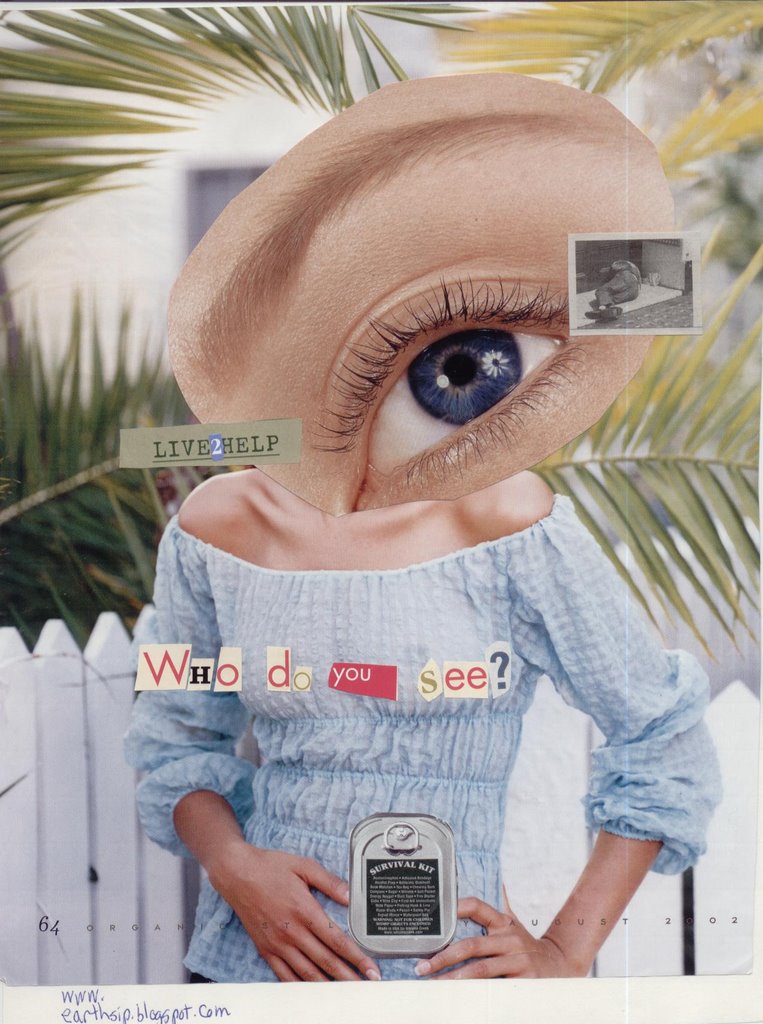
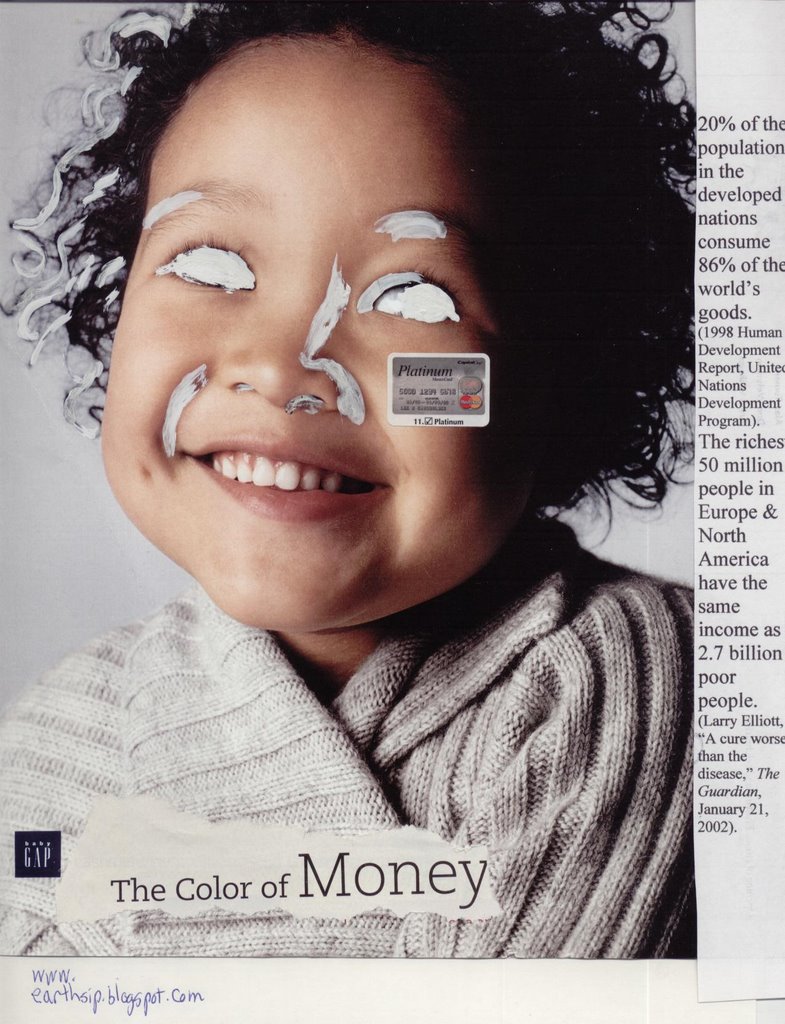
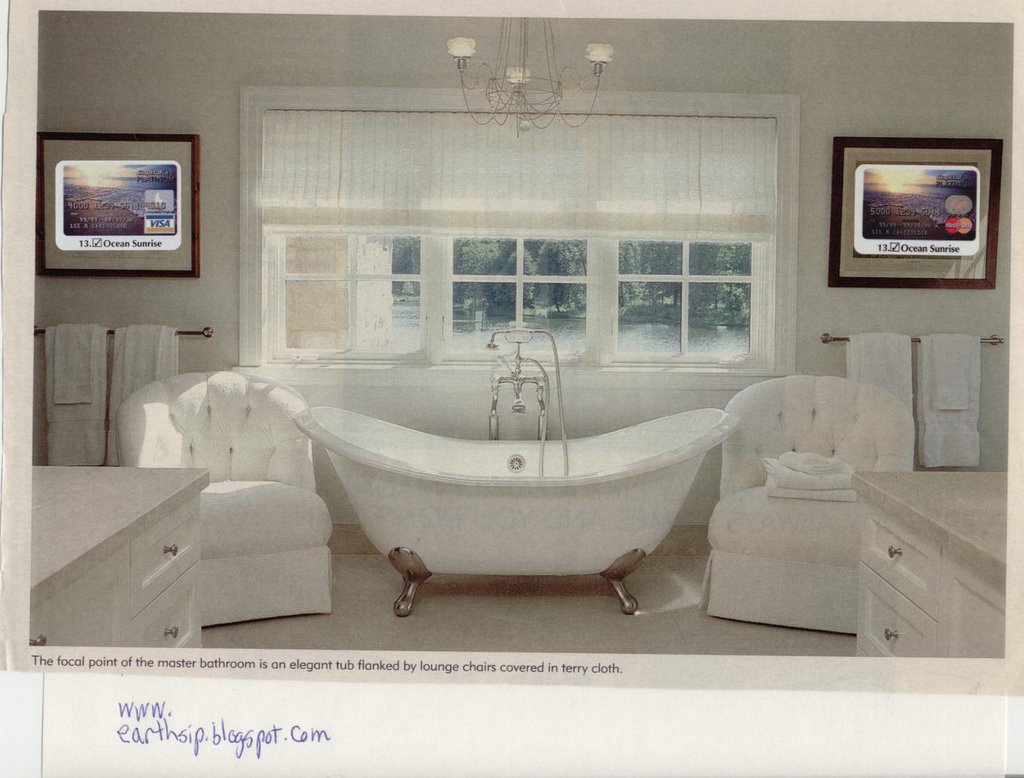
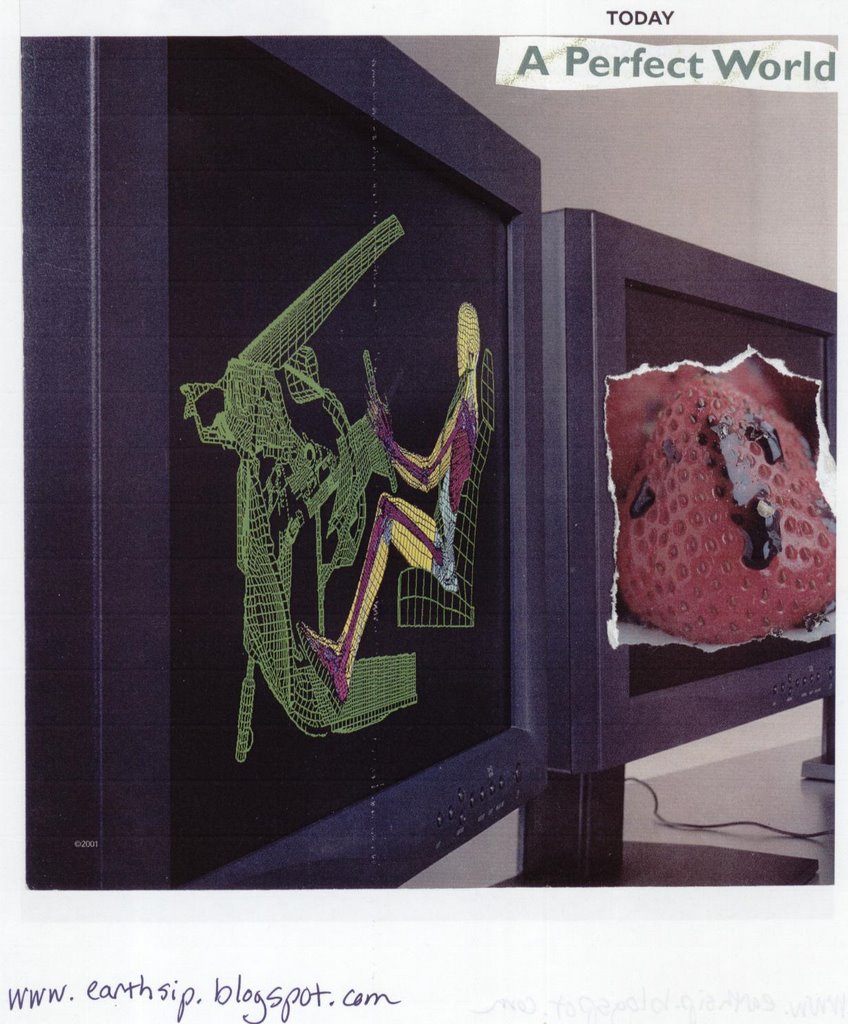
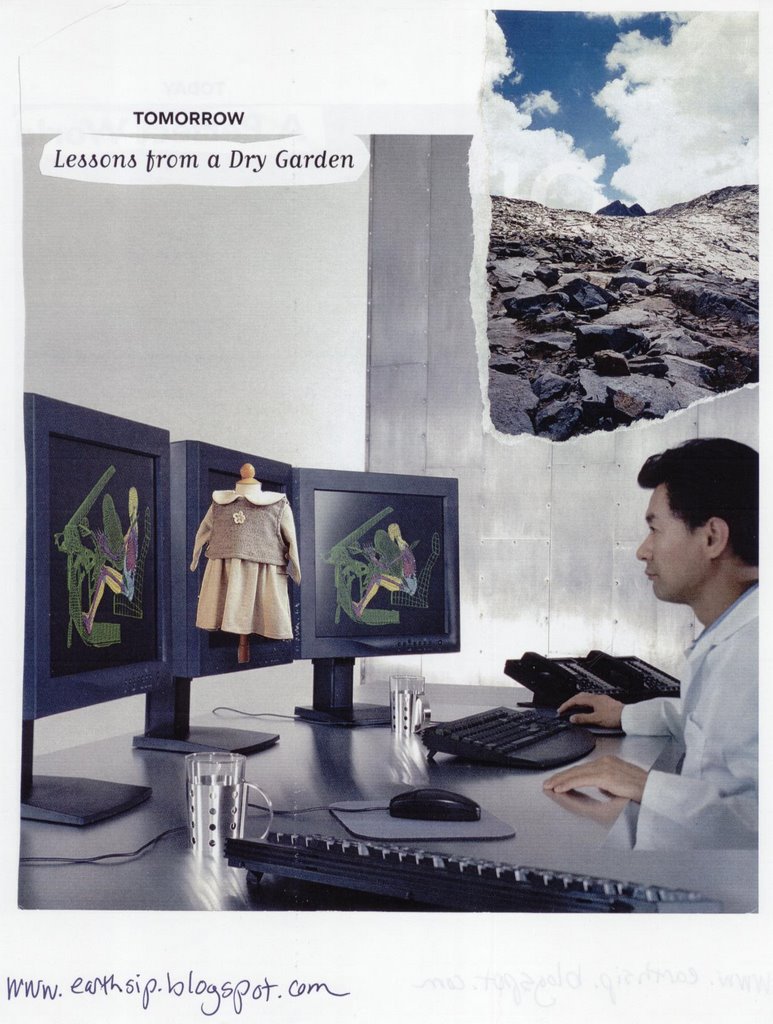
Except for one "Drawing 101" class, I'm not trained as an artist, so maybe that's why collage interests me: it's definitely grassroots, outsider art. Probably a stretch to say that it's inherently more political, though. And Wite-Out art, or, as I like to call it, "Planet Pleaser White Multi-Purpose Correction Fluid" art (since that is the vegan product that I use to create mine) is even more so. Easily accessed materials, found in most desk drawers nowawdays. Using Wite-Out/Planet Pleaser on an image feels similar to Asian brush painting: it's not about making lines go the way you want them to so much as creating spaces that weren't there before, and even further, creating what I think of as negative spaces. Like the child's eyes: what was warm and alive is negated, blanked out. The bottom right corner, where the paper pieces don't meet was intentional---only machines can make something perfect, and a machine is the last thing I want to be.
To find out how you're doing in the consumption realm, try this quick quiz.
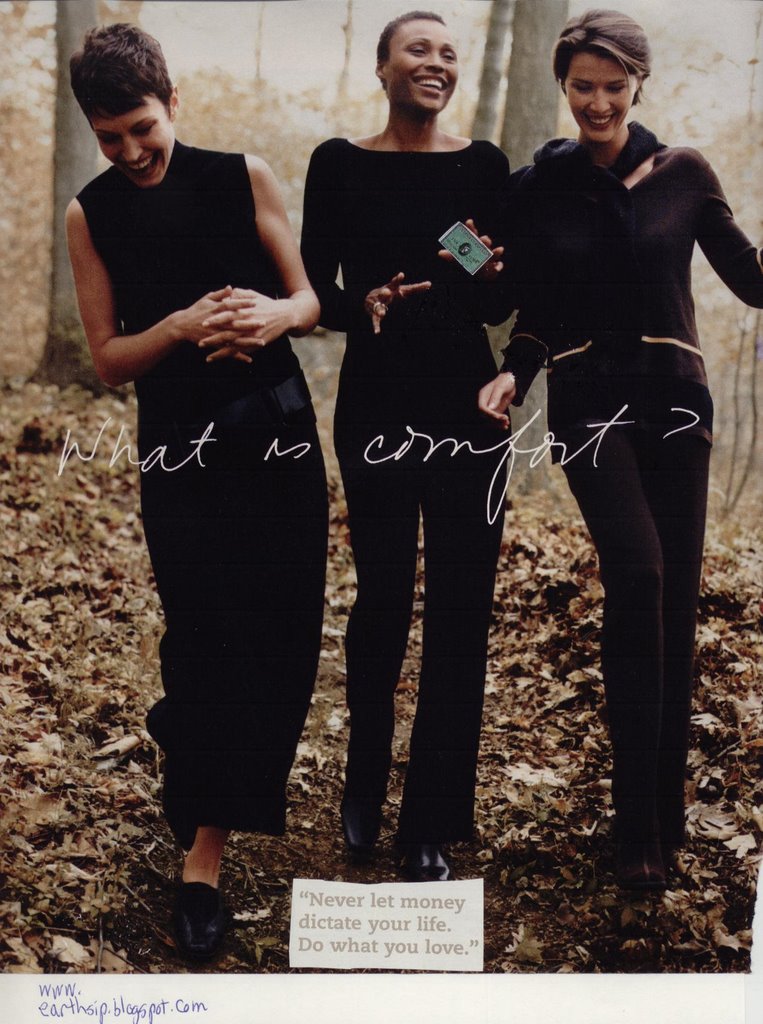
What is that is keeping you from your life?
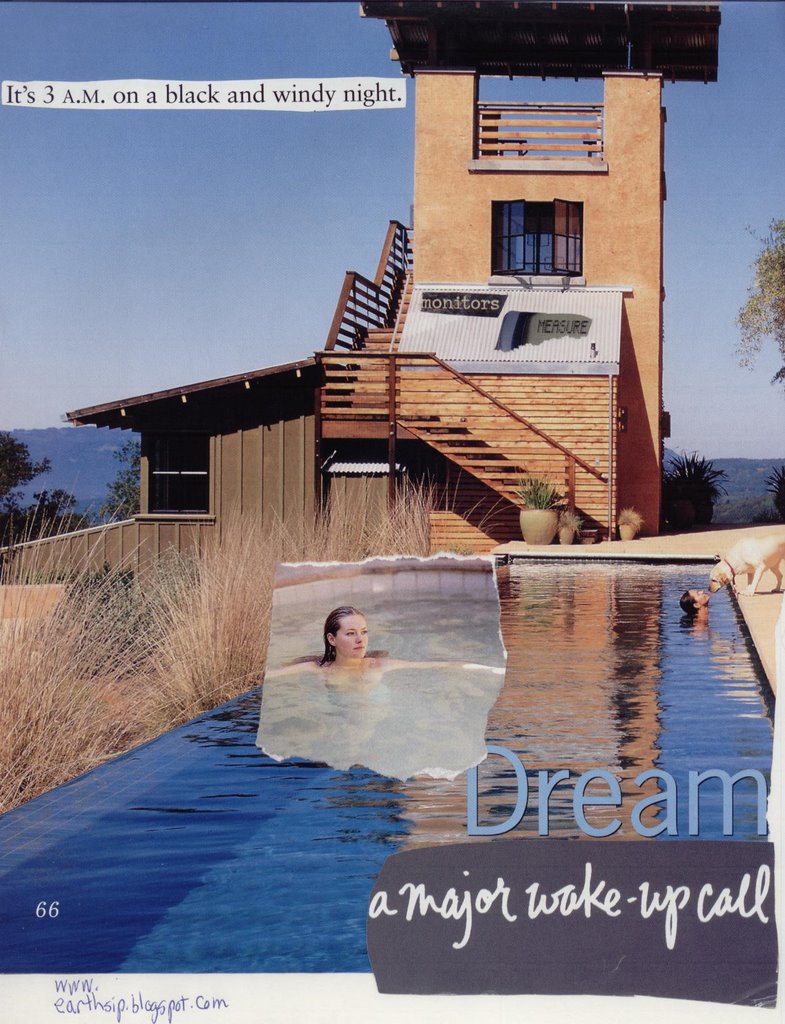
(by Marina)
When I created this, I was thinking about how dreams often tell us the truth we can't tell ourselves in the daylight; how our dreamlife is just as real as our waking life; and how, even on a lazy, hot afternoon, we contain the seeds of that dreamlife self from when it's 3 am on a black and windy night. For one of my friends, it made him think, "What is that is keeping you from your life?"
You might have entirely different thoughts about these images...
"A standard beef slaughterhouse kills 250 cattle every hour"
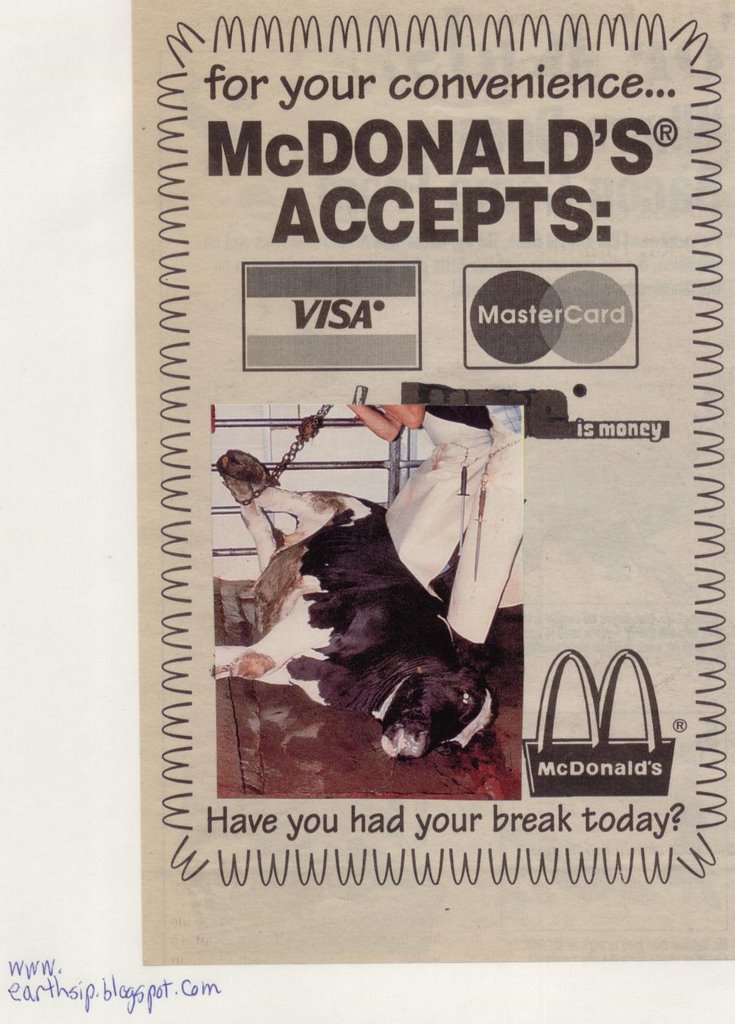
"The high speed of the assembly line makes it increasingly difficult to treat animals with any semblance of humaneness. A "Meat & Poultry" article states, 'Good handling is extremely difficult if equipment is "maxed out" all the time. It is impossible to have a good attitude toward cattle if employees have to constantly overexert themselves, and thus transfer all that stress right down to the animals, just to keep up with the line.'" --- from FactoryFarming.com
Wednesday, October 11, 2006

Saturday, September 23, 2006

A simple solution to war and global warming
(by Marina)
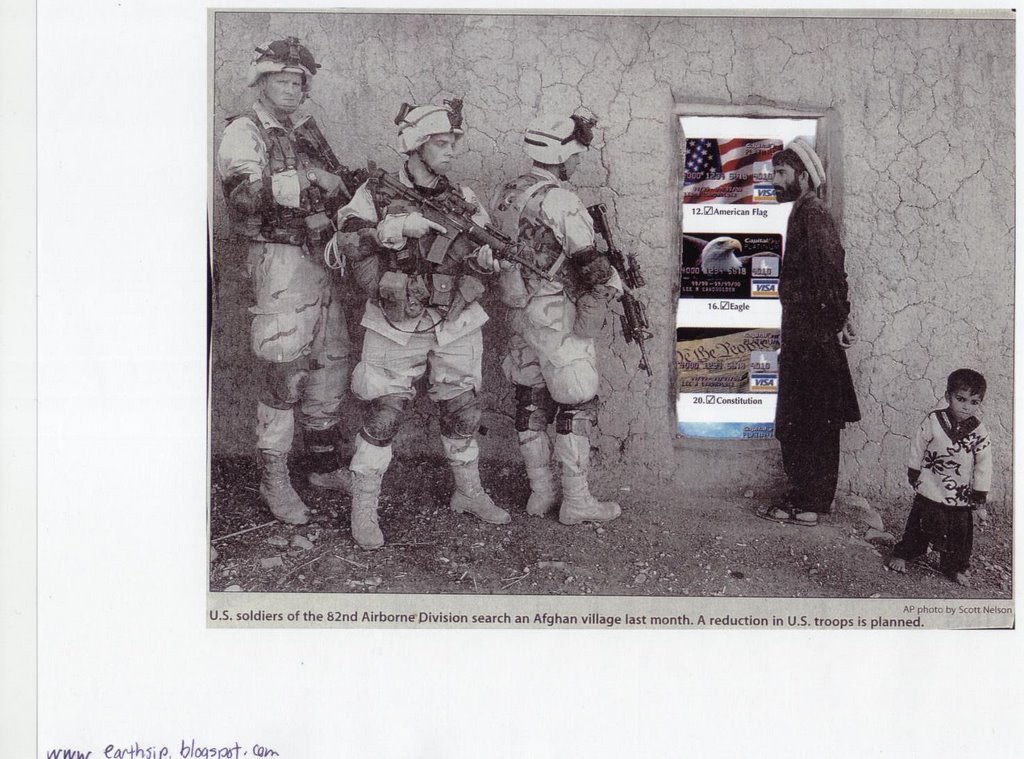
A friend of mine, who has just turned 60, is quitting her job, retiring so that she can live on a $734 a month retirement income, thus, living below the federal poverty line, so that she'll no longer be paying taxes that go to support war. She is an utterly amazing woman. When the U.S. military was blaming a lack of yellow "caution" tape" for its failure to protect Iraqi children from abandoned munitions, my friend bought reams of tape and mailed it to them. She has also visited Iraq as a member of a christian Peacemaker team, and in the article she wrote about the experience, she points out that among its many "downsides," war contributes to environmental degradation and global warming. Hoping to minimize her impact on the planet, my friend uses almost no electricity, has no car, avoids recreational travel, and buys locally produced food. In a local newspaper article about her decision to be poor, she says, "It's wrong for people to keep looking for someone to lead us. We all have to take personal responsibility. I want people to know this is an alternative." I would add that to take responsibility is to empower yourself, an invigorating and peaceful act. I only hope I can do so much.
A friend of mine, who has just turned 60, is quitting her job, retiring so that she can live on a $734 a month retirement income, thus, living below the federal poverty line, so that she'll no longer be paying taxes that go to support war. She is an utterly amazing woman. When the U.S. military was blaming a lack of yellow "caution" tape" for its failure to protect Iraqi children from abandoned munitions, my friend bought reams of tape and mailed it to them. She has also visited Iraq as a member of a christian Peacemaker team, and in the article she wrote about the experience, she points out that among its many "downsides," war contributes to environmental degradation and global warming. Hoping to minimize her impact on the planet, my friend uses almost no electricity, has no car, avoids recreational travel, and buys locally produced food. In a local newspaper article about her decision to be poor, she says, "It's wrong for people to keep looking for someone to lead us. We all have to take personal responsibility. I want people to know this is an alternative." I would add that to take responsibility is to empower yourself, an invigorating and peaceful act. I only hope I can do so much.
Subscribe to:
Posts (Atom)